






Laser Refractive Surgery
Laser Refractive Surgery

Prof. Dr. Efekan Coşkunseven
Ophthalmology Specialist · Şişli, Istanbul
+200,000 Operations Performed
Prof. Dr. Efekan Coşkunseven Laser Refractive Surgery
Personalized and Internationally Referenced Approach to Refractive Errors
Firsts in Turkey and the World
He is a globally recognized authority in keratoconus, whose treatment protocols have informed the training of numerous physicians worldwide.
Laser Refractive Surgery
Laser refractive surgery is a surgical treatment used to correct refractive errors such as myopia, hyperopia, and astigmatism. The procedure works by reshaping the cornea using a laser, which allows light to focus more accurately on the retina and corrects the underlying vision impairment.
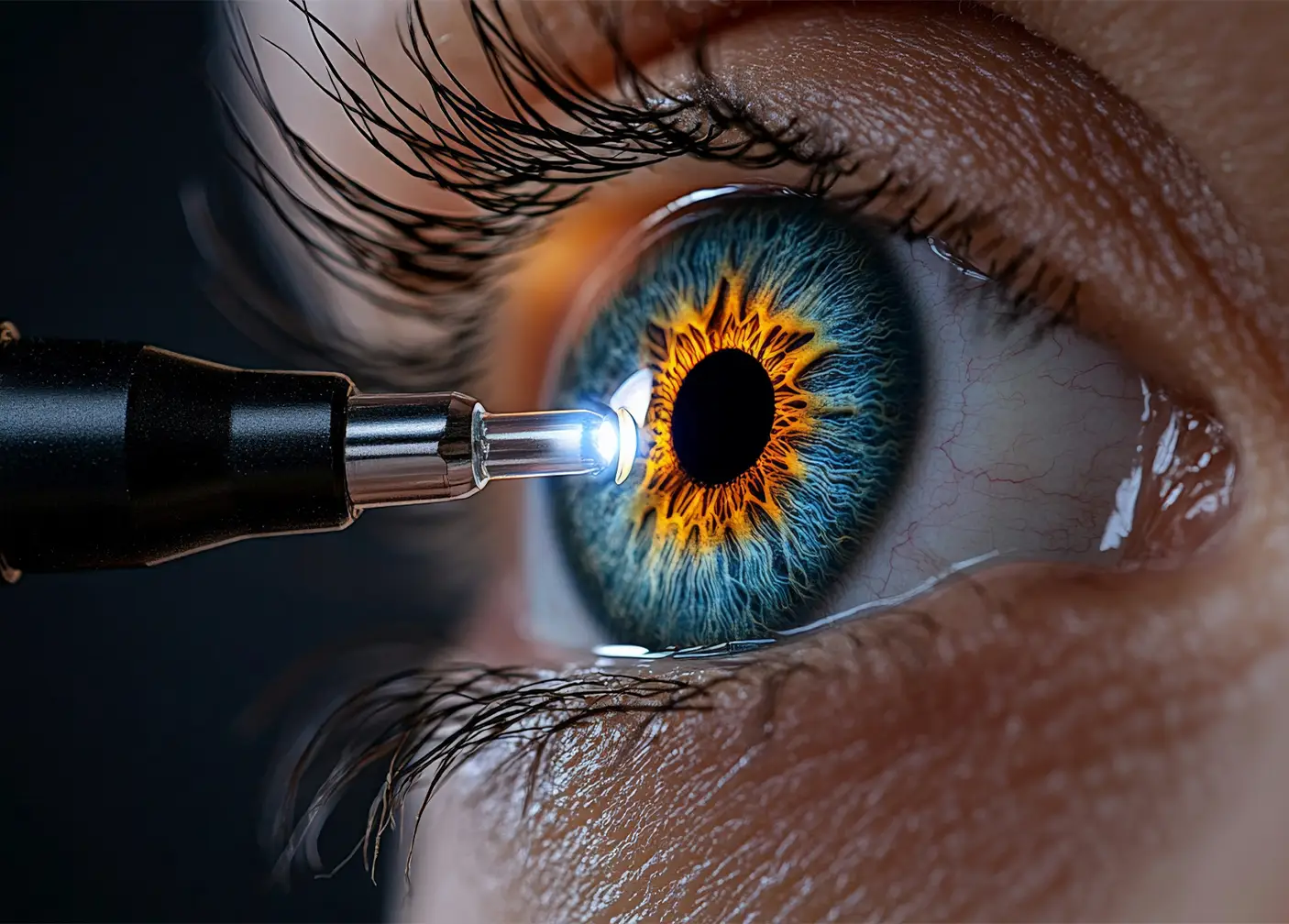
Refractive Error: What You Need to Know
A refractive error is a vision problem that occurs when the eye cannot bend light correctly. These conditions typically result from abnormalities in the curvature of the cornea or the length of the eye. The most common refractive errors are myopia, hyperopia, and astigmatism.
Myopia (Nearsightedness): Myopia causes distant objects to appear blurry. It occurs when the eye is too long or the cornea is too steeply curved, causing light to focus in front of the retina rather than directly on it.
Hyperopia (Farsightedness): In hyperopia, the eye may be too short or the cornea too flat, causing light to focus behind the retina. This makes it difficult to see nearby objects clearly.
Astigmatism: Astigmatism occurs when the cornea or lens has an irregular curvature, causing blurred vision at both near and far distances.
Refractive errors can affect daily life, but a range of treatment options is available to correct them.
Laser Refractive Surgery: An Overview
Laser refractive surgery is a surgical treatment used to correct refractive errors such as myopia, hyperopia, and astigmatism. The procedure works by reshaping the cornea — the clear front surface of the eye — using a laser, allowing light to focus more accurately on the retina and thereby improving vision.
The goal of laser eye surgery is to reduce or eliminate your dependence on glasses or contact lenses, improving your overall quality of life. Several distinct laser techniques — including LASIK, PRK, and lenticule extraction surgery (SMILE) — allow patients to achieve rapid, effective results.
LASIK (Laser-Assisted In Situ Keratomileusis): One of the most widely performed laser eye surgery techniques, LASIK involves creating a thin flap on the surface of the cornea. The underlying corneal tissue is then reshaped with a laser to correct your refractive error and improve focusing ability. The flap is repositioned at the end of the procedure and heals naturally.
PRK (Photorefractive Keratectomy): In PRK, the corneal surface is reshaped directly with a laser. During the procedure, the outermost corneal layer (the epithelium) is removed — either manually or using a laser in the No Touch technique — after which the deeper corneal tissue is reshaped. The epithelium regenerates on its own over the following days.
Lenticule Extraction Surgery (SMILE — Small Incision Lenticule Extraction): SMILE is a more recent technique compared to LASIK and PRK. A small disc of corneal tissue (the lenticule) is created within the cornea using a laser and then removed through a small incision. This approach is primarily used to treat myopia.
Who Is a Candidate?
Individuals with vision problems caused by refractive errors, good overall eye health, and a stable prescription may be suitable candidates for laser eye surgery.
Efekan Coşkunseven — Refractive Surgery Experience
Assoc. Prof. Dr. Efekan Coşkunseven has been involved in refractive surgery since 1996 and served as Director of the Refractive Surgery Division at Dünya Göz Hospital from 2003 to 2023. Over the course of his career, he has performed more than 40,000 LASIK and more than 120,000 iLASIK procedures.
Advanced Surgical Training (2000)
Completed advanced refractive surgery training under Prof. Ioannis Pallikaris (University of Crete), widely regarded as one of the founding figures of laser eye surgery.
First WaveLight Excimer Laser in Turkey (2001)
Performed the first LASIK procedure in Turkey using the WaveLight excimer laser platform.
First IntraLase Laser in Turkey (2003)
Became the first surgeon in Turkey to perform LASIK using the IntraLase femtosecond laser.
International Instructor (2004)
Selected by Johnson & Johnson (AMO, California, USA) as an international IntraLase Proctor (certified instructor). He remains one of a small number of credentialed IntraLase instructors worldwide.
First Epi-LASIK and CK Procedures in Turkey (2003–2004)
Performed the first Epi-LASIK procedure in Turkey (2003) and the first Conductive Keratoplasty (CK) procedure in Turkey (2004).
PresbyLASIK and Corneal Inlay Pioneer (2006)
A pioneer in Turkey for PresbyLASIK (laser treatment for near vision correction) and corneal inlay implantation (KAMRA, 2006).
Pioneering Laser Applications
Introduced wavefront-guided and topography-guided LASIK (TopoLASIK), as well as Q-value LASIK, to Turkey for the first time.
Firsts with Innovative Devices
The first surgeon in Turkey to perform multiple laser procedures using the Schwind microkeratome, Moria M2, and Hansatome XP platforms.
Prof. Dr. Efekan Coşkunseven
Treatments
Address
Medicana Zincirlikuyu Hastanesi
Full Address:
Esentepe Mah, Büyükdere Cd. No:165, 34394 Şişli/İstanbul